Phenomena
A data stream contains uncorrelated, simple events, e.g. sensor data on a room’s temperature at a given point in time.
However, there may exist correlations among sensor data to indicate higher-level phenomena occurring in the physical space that simple data events alone cannot identify. Identifying such phenomena would give rise to higher-level complex events which, in turn, can be used to detect further complex phenomena, and so on.
Therefore, a phenomenon represents some (real-world) circumstance that one may wish to model in the system by observing patterns in streaming data that, when fulfilled with applicable data events, infer the existence or occurrence of the phenomenon at that point in time.
In BoboCEP, a phenomenon has one or more patterns whereby, if any of
the patterns were fulfilled with appropriate data, then a complex event is
generated to represent that the phenomenon was identified at that given
point in time, with correlated data events as evidence for this observation.
Patterns
Patterns are modelled as a series of blocks, with each block containing one or more predicates.
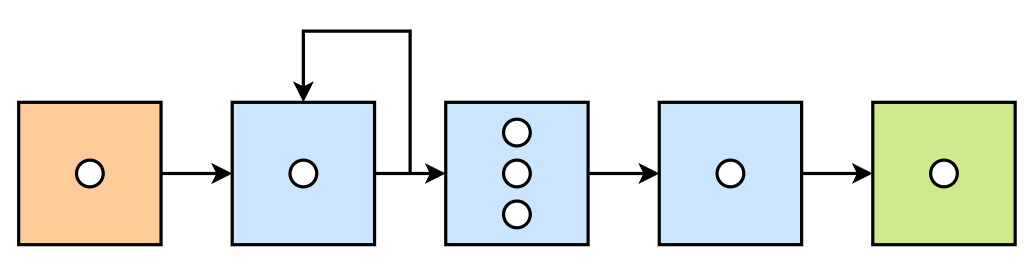
A series of blocks for a pattern. White circles represent predicates. Starting block is orange, intermediary blocks are blue, and final block is green.
Fulfilling a pattern starts with an event that satisfies the predicate of the first block of the pattern. From there, a run is generated to track the progress across the blocks of the pattern (see Runs).
Checking an event against a predicate is as follows.
def evaluate(self, event: BoboEvent, history: BoboHistory) -> bool:
    ...
During evaluation, the event being checked is passed, as well as the
history of all events that were previously accepted by the previous
blocks in the series.
If any predicate in a block evaluates to True, the event is
accepted and added to the history, and the block moves to the next block in
the series.
Each block can have a group name associated with it, which will be used in
the history to group accepted events. Multiple blocks can share
the same group name.
Blocks can have the following additional properties.
Negated
Negated blocks can check whether an event does not pass its predicate
i.e. predicate success is based on whether it returns False
instead of True.
First and final blocks cannot be negated.
A negated block cannot also be optional (see next).
Optional
Optional blocks may be satisfied by an event but, if not, then the event is also checked against the subsequent block. If that block is also optional, it continues on until either an optional block is satisfied by the event, or a non-optional block is reached. First and final blocks cannot be optional. As stated, an optional block cannot also be negated.
Looping
Looping blocks enable both the current block and next block to be potential paths through a pattern’s block series. First and final blocks cannot loop. A looping block can neither be negated nor optional.
Contiguity
If an event is checked against a block and is not accepted, then contiguity determines what should happen next.
Strict contiguity means that the pattern should halt (i.e. stop) and all progress towards the final block is lost. A strict block cannot also be optional.
Relaxed contiguity means that the pattern can tolerate events entering the system which it does not require for its pattern.
Conditions
In addition to blocks, there are also preconditions and haltconditions. These are additional predicates against which an event is evaluated before passing the event onto the current block’s predicate(s).
Preconditions are predicates whereby, if an event does not successfully match against all predicates, then the pattern will halt. If it does match against them all, then the event will be passed to the current block of the pattern. For example, a precondition may be that all data originates from a single IP address.
Haltconditions are predicates whereby, if an event successfully matches against any predicate, then the pattern will halt. If it does not match any haltcondition, then the event will be passed to the current block of the pattern. For example, a haltcondition may be to halt if 60 seconds has passed since the first event in the history i.e. the pattern must reach completion within 60 seconds.
Note
Preconditions will cause a pattern to halt if it encounters any event that does not satisfy the predicates of all preconditions. That is, preconditions provide strict contiguity. Unless you are also using strict contiguity in all of your patterns, it may be best to avoid using preconditions.
Pattern Builder
Creating a pattern is best achieved using the BoboPatternBuilder.
from bobocep.cep.phenom import BoboPatternBuilder, BoboPattern

builder = BoboPatternBuilder(name="my_pattern")
Methods
nextandnot_nextare used for strict contiguity and negated strict contiguity, respectively;Methods
followed_byandnot_followed_byfor relaxed contiguity;Methods
followed_by_anyandnot_followed_by_anyfor non-deterministic relaxed contiguity;Methods
preconditionandhaltconditionto provide predicates accordingly.
For example, in most applications, followed_by will be the
most suitable choice.
builder.followed_by(
    predicate=lambda e, h: type(e.data) == int and e.data == 15,
    group="my_group",
    times=3,
    loop=False,
    optional=False
)
In the example above, predicate lambda e, h is a function consisting
of event e to check and the current history h of all previous
events accepted by the run.
Event e is a subtype of BoboEvent and h of type
BoboHistory.
Additionally, optional arguments have been provided:
A group name
my_groupin which the history will store this event, should an event be accepted by this predicate.The
timesoption adds three blocks, in series, to the pattern, all with identical characteristics. That is, The predicate will need to be satisfied3times by3separate events.The
3blocks are not self-looping.The
3blocks are not optional.
pattern: BoboPattern = builder.generate()
Runs
Runs serve as instances of patterns. Each pattern can have multiple runs at any given time, for example, if the first predicate of the pattern is satisfied multiple times.
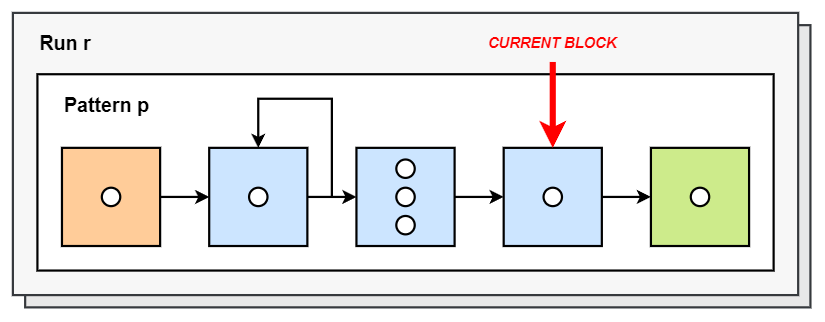
Run r serves as an instance of pattern p and
keeps track of its state across the pattern’s blocks.
Runs work as follows:
When the first predicate of a pattern has been satisfied by an event, a run is generated.
The run continues to monitor the state of the partially-completed pattern as more and more events ‘push’ the currently-monitored block towards the pattern’s final block.
Once the final block’s predicate has been satisfied, the Producer is notified of the completed run, leading to the Producer generating a complex event which is sent to the Receiver.
The Forwarder, in turn, executes the associated phenomenon’s Action (if one exists). Once it has finished execution, whether successful or not, an action event is produced and sent to the Receiver.
If a run needs to end before reaching the final state (e.g. because of a contiguity requirement or satisfied haltcondition), then it enters a halted state and is removed from the list of active runs.